The feeding of the 5000 in John 6
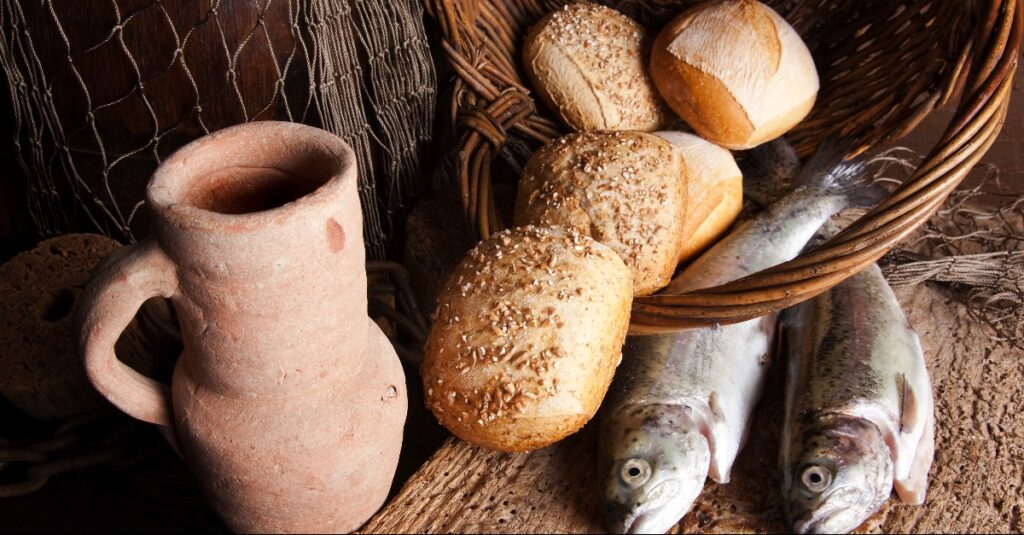
The lectionary takes us from famine to banquet—metaphorically and literally!—as nosotros move from the sparse verses near Jesus' ministry in Mark vi to the lavish feast of both the feeding of the 5,000and Jesus walking on the water in John six. Whilst we might have struggled to observe a sermon on final week's readings, there must be material for several in this week's!
The challenge in reading this passage relates to the pregnant of the text in its context, and the devotional and theological utilize of information technology by later readers. The chief theological question is whether this text is 'eucharistic', that is, providing a back story (as information technology were) to early church exercise of jubilant Communion. But there is also the devotional question raised by popular readings: is this story primarily about the male child who offered his meagre luncheon, or is the focus more than on what Jesus does with it?
The feeding of the 5,000 is the simply miracle of Jesus that is related in all four gospels, and the Fourth Gospel'south is the longest business relationship, followed by Mark, with Luke's and Matthew's both beingness almost ii-thirds of the length of Mark's. The business relationship in John half-dozen has a different setting from the Synoptics, since information technology has focussed on the activity of Jesus in Jerusalem in John v, where the Synoptics have related the sending out of the Twelve and their return, which is not mentioned in the Fourth Gospel though the account fits with it. We can see hints of the dovetailing of the accounts, for example in the language of John 6.ane 'Jesus went to theother sideof the Sea…'; this reference makes no sense on its own (since Jesus has been in Jerusalem) and so must be read in parallel with the events in the Synoptics, and in item with Marking.
The synoptic gospels consistently refer to the lake as the 'Sea of Galilee', but our passage adds to this appellation the proper name that became pop in the later outset century, 'Sea of Tiberias' (here and in John 21.i). This shifts our attention from the region as the place of fulfilment of OT expectation (Is ix.1–ii equally cited past Matt 4.15), and towards this as a region occupied by a foreign power and the place of power struggles betwixt kings. We will therefore not be surprised when the theme of kingship arises prominently at several points in the passage.
The 'peachy crowd' (ὄχλος πολύς) reminds usa of this theme in Marking, and Jesus 'healing the sick' which they take seen and heard again relies on our familiarity with Mark and the other synoptics, which all relate these healings immediately prior to the feeding upshot. Rather than describing these as expressions of Jesus' compassion, or demonstrations of the coming of the kingdom, the Fourth Gospel characteristically labels them as 'signs', things which are not an end in themselves, but bespeak to something greater. (The text doesn't even actually mention 'healing'; literally, they 'saw the signs he was doing on the sick.')
The description of Jesus going 'up on the mount' and sitting down with his disciples offers a powerful echo of Moses going up on Mt Sinai, just as it does at the first of the Sermon on the Mount in Matt five.1, and the mention of the Passover, the festival commemorating the Exodus, reinforces this. The language of 'the banquet/festival of the Jews' does not suggest an anti-semitic perspective, since the Jewish festivals and observances are so central to this gospel. Rather, it suggests that the gospel is written to let non-Jews to read and understand it.
'Jesus lifted up his optics and saw…' is a redundancy which again reminds us of OT precedents. Despite the traditional site of Tabgha, but west of Capernaum, marked by the Church building of the Loaves and Fishes, the location is more probable to be due east of the Jordan river near Bethsaida equally Luke 9.ten informs us. At that place is a prissy 'undesigned coincidence' here, pointing to historical reliability: the business relationship of the Fourth Gospel does not mention the location, merely does mention that Jesus asked Greek-speaking Philip for information (John 6.5); and earlier in the gospel we learned that Philip was from the Greek-speaking region of Bethsaida (John i.44). (There is a question of how the crowd, on foot, crossed the Hashemite kingdom of jordan river; but we exercise not have plenty archaeological detail to know whether at that place was a span or ford at the fourth dimension. Note as well that this is one signal where geographical location is hard to harmonise with Mark's account.)
Jesus asks Philip how all these people might be fed, to 'exam' (πειράζων) him. The term for 'testing' is often highly negative, but can exist used neutrally or, as here, positively. Jesus wants to see whether Philip has the eyes of organized religion, simply at the moment he merely sees the applied challenge. A denarius was the usual twenty-four hours's pay for a manual worker, so 200 denarii would a little more than than one-half a yr's wages. The narrative issue of this exchange is to emphasise the magnitude of Jesus' miracle; what he achieves is not simply difficult for an ordinary person, it is impossible. And, as is characteristic of his portrayal in the 4th Gospel, Jesus knows what he is doing and what volition happen in contrast to the baffled disciples.
All iv accounts agree that there are 'five loaves and two fish', but only John 6 tells the states the detail of where they accept come from, a male child in the crowd—which, once more than, appears to have no more significance that the fact that it happened this way. Andrew is involved since, as we learnt in John 1.44, he too like Philip was from the region of Bethsaida. The Fourth Gospel alone adds the detail that these werebarley loaves, peasants' fare which was cheaper than wheat breadstuff merely harder to eat. The 'fish' here isopsarionrather thanichthus as in the synoptics; it would refer to pieces of fish, peradventure preserved, which would be a tidbit eaten as an appetiser, rather than whole fishes (thus the motion-picture show at the peak, and all other images of this issue, are incorrect).
The narrative passes over the particular of how the people sit down, though information technology is given in Marking half-dozen.39–40 as well as in Luke 9.xiv; Marker 6.39 also tells us that the 'grass' was 'green', which confirms the Fourth Gospel's timing of the effect at Passover in the Spring, though Mark omits mention of this timing. Information technology was mutual to number a crowd past counting 'the men', in contrast to the previous mention of 'people'; Matthew fourteen.21 reminds us that women and children were present, though we knew that already from the mention of the boy who provided the lunch.
In the synoptic gospels, we read of Jesus doing the four-fold acting of 'taking…approving…breaking…and giving' (Matt 14.19, Mark vi.41, Luke 9.sixteen), which has been read equally echoing early church practise in the Lord's supper, but here he merely 'took, and when he had given thanks, distributed.' If there is any correlation with later on rituals, the Fourth Gospel appears rather uninterested in it, which fits with its general lack of interest in what afterward became 'sacraments'. This episode doesn't point to the ritual actions of communion; rather, this miracle, and the ritual meal of Communion, both betoken to Jesus the true bread.
Jesus 'giving thanks',eucharisteo, is parallel to Marker's 'he blest',eulogeo, confirming what nosotros detect elsewhere that these 2 terms are used interchangeably, and that the 'blessing' that happened was a blessing of God, the Jewish prayer of berakhah, not of the things he had in his easily. In all 4 gospels, the primary allusions here are not to later, ritualised church practice, but to previous episodes in Scripture. Crossing the water, arriving in a wilderness, organising the people into companies, sharing breadstuff, having more than enough, gathering what is left—all these remind the states of the provision of manna in the desert under the leadership of Moses. There are also strong parallels with the prophetic actions of Elisha in ii Kings 4.42–44, when a big grouping are fed with a few barley loaves. Both hither and in the Terminal Supper we see Jesus, in Jewish context and using Jewish customs, anticipating the heavenly banquet in parallel with his teaching near the kingdom of sky, feeding the people with both words and breadstuff.
The synoptics all note the twelve baskets of leftovers that were collected (presumably one handbasket per disciple) as well equally noting that 'all were satisfied'. The Quaternary Gospel accentuates this by the repetition, 'as much every bit they wanted…they had eaten their fill…left by those who had eaten'. It is the provision of and by Jesus that truly satisfies the people.
The concern of Jesus, 'that null may be lost', could be understood in merely practical terms; the food can go along to sustain the oversupply in the days that follow. Simply it also appears to have a symbolic significance, since Jesus later on talks (in prayer) of not having lost any of the ones that the Father had given him (John 17.12, compare John 18.ix).
The motifs related to Moses at present come dorsum with total force; the people recognise Jesus as the 'prophet that was to come into the earth', echoing the promise of Moses in Deut 18.fifteen. In addition, the Fourth Gospel makes explicit the themes of kingship that were implicit in the synoptic accounts, and specially Matthew. Early in this gospel, Nathanael has declared 'Rabbi, you are the son of God, you are the king of Israel!' (John 1.49). At Jesus' entry into Jerusalem, the crowds volition proclaim 'Blest is the male monarch of Israel!' (John 12.13, 12.15). At his trial, the exchange with Pilate volition centre around Jesus' identity every bit king (John 18.33, 37). And Pilate affixes the charge confronting Jesus that he is 'Kings of the Jews' (John nineteen.nineteen–22).
Simply Jesus is clear that his kingdom is non 'from' this world (John xviii.36, not, as in some translations 'notof this earth'). His kingdom is this-worldly enough—after all, he has just fed a crowd! But his authorization does non derive either from the will of the people (the consensus omnium so important to Roman emperors), or from political power plays, and so he refuses to exist the kind of male monarch that the people want.
The 4th Gospel agrees with Matthew and Mark in including the miracle of Jesus walking on the h2o immediately following the feeding event, only the account here is briefer than either of the others, not least because Matthew includes the detail of Peter stepping out of the gunkhole to meet Jesus on the water (and so it becomes a full lectionary reading). It is normally considered to be the 5th of the '7 signs' in the first half of this gospel, just because of the brevity (and because the give-and-take 'sign' is omitted, as is often the case) some don't include it in the list of seven, seeing vi signs here with Jesus' resurrection as the seventh.
Mark's account brings out the OT allusions to God equally the ane who walks on the waters, peculiarly by including the phrase 'he meant to laissez passer them past' (Mark 6.48) equally an apparent allusion to Job 9.eleven. But in its position here in John 6, in that location are articulate echoes of kings challenge divinity by walking on water.
Western farsi King Xerxes builds a bridge of boats beyond the Bosphorus and then that he tin imitate Poseidon in c 480 BC. Caligula imitates Xerxes past crossing the Bay of Naples. Trajan's conquest of the Dacians is represented on his victory column by depicting his troops crossing the Danube on a flotilla of boats. (Jo-Ann Brant,Paideia, p 118).
Jesus is not king considering of the acclamation of the people, but because of the presence and authority of God that characterise his actions. The disciples react with fear at the sight of him, as they do in Matthew and Mark, but his response to them here does not offering the reassurance nosotros read in the other accounts, only directly offers Jesus' claim 'It is I!' This translates the Greek phrase elsewhere interpreted equally 'I am', echoing the proper name of God revealed to Moses in Ex 3.14 and deployed in Is 43.25 to denote the uniqueness of the God of Israel.
Jesus is the true king, who provides for the needs of his people, both physical and spiritual. Nothing and no-1 is lost from those who receive his grace. Information technology is his presence—the presence of God himself—who quietens the storm and brings united states of america to our final destination.
If you enjoyed this, do share information technology on social media (Facebook or Twitter) using the buttons on the left. Follow me on Twitter @psephizo. Like my page on Facebook.
Much of my work is done on a freelance basis. If you lot have valued this post, you lot can make a single or repeat donation through PayPal:
Comments policy: Expert comments that engage with the content of the post, and share in respectful argue, tin add together existent value. Seek first to empathise, and so to be understood. Make the most charitable construal of the views of others and seek to learn from their perspectives. Don't view argue as a conflict to win; address the statement rather than tackling the person.
Source: https://www.psephizo.com/biblical-studies/the-feeding-of-the-5000-in-john-6/
0 Response to "The feeding of the 5000 in John 6"
Enregistrer un commentaire